A pump that clicks on and off every time a tap runs, pressure that jumps up and down in the shower, or a tank that is wet and rusting at the base: these point at the pressure tank. Here is what the tank does, how a pro tells whether it can be recharged or needs well pressure tank replacement, and what the job involves.
Water Well Repair Near Me is an independent referral service, not a well contractor, pump installer or plumber. When you send the form, your request goes to this site’s operator, who passes it to an independent local well pro who can contact you and prepare a quote for the work.
What a well pressure tank does
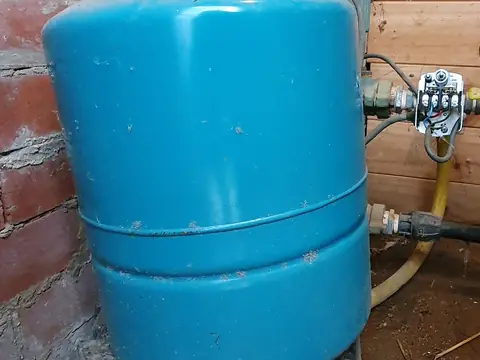
A well pump cannot run every time someone fills a glass. The pressure tank is the buffer. It holds a store of water under pressure against a cushion of air. When a tap opens, the air pushes water out of the tank and into the pipes. Only when the pressure falls to a set point does the pressure switch start the pump, which refills the tank until the pressure reaches the higher set point and the switch turns it off.
That simple job matters a great deal to the rest of the system. A tank that works lets the pump run in longer, steadier cycles. A tank that has lost its air cushion cannot store water under pressure, so the pump starts and stops over and over for every small draw. That is called short cycling, and it is the symptom to look for when a pump clicks.
Bladder and diaphragm tanks
Bladder and diaphragm tanks keep the air apart from the water, with a rubber bladder or a diaphragm inside a steel shell. The air side has a valve, like a tire valve, where the air charge is checked and set. Older plain steel tanks have no bladder: air and water touch, and the air is slowly absorbed into the water over time, which is why those tanks need their air topped up and why some owners replace them.

Signs the pressure tank is failing
| What you notice | What it can mean |
|---|---|
| The pump clicks on and off over and over | The tank has lost its air charge or the bladder has failed, so the tank is waterlogged |
| Pressure at the tap jumps up and down quickly | Too little stored water between pump starts |
| The gauge needle drops fast as soon as a tap opens | Little or no air cushion in the tank |
| Water comes out of the air valve | A failed bladder: water has reached the air side |
| Rust, wet spots or a leak at the tank | A shell that is corroding or a fitting that has failed |
| Spurting taps or air in the lines | Can come from the tank, the pump or a low water level in the well |
Short cycling is the one to act on. A pump that starts many more times than it should works harder than it needs to, and protecting the pump is one of the best reasons to deal with a failing tank promptly. If you are not sure which part is at fault, the well pump repair page explains how a pro works through the system from the top down.
Checks you can make without tools
Leave the switch, the air valve and any wiring alone. The pressure switch is live electrical equipment. These checks need nothing but your eyes and ears:
- With no water running, note what the gauge reads.
- Open a tap and watch the gauge. Note how quickly it falls and the reading when you hear the pump start.
- Close the tap and note the reading when the pump stops.
- Count roughly how often the pump starts while a tap runs, and listen for clicking at the switch.
- Look at the tank for rust, damp patches or water on the floor.
Those notes tell the pro a lot before they arrive. Put them in the form’s notes on the contact page, or have them ready when the pro can contact you.
Pump clicking on and off? Say what the well is doing and give your ZIP code.
Recharge, repair or replace
Not every tank problem needs a new tank. The pro decides from what they find:
- Recharge. If the bladder is sound and the tank has simply lost air, the pro may set the air charge again with the system drained, matched to the pressure switch’s settings.
- Repair the controls. If the tank is fine and the switch, the gauge or a fitting is the problem, that part is replaced.
- Replace the tank. If the bladder or diaphragm has failed, if water comes out of the air valve, or if the shell is rusting or leaking, the tank is replaced. A failed bladder in a sealed tank is not something that can be patched.
Ask the pro to show you what they found. Water at the air valve or a tank that will not hold its charge are things you can see for yourself.
What pressure tank replacement involves
- Power to the pump is turned off at the breaker, so it cannot start during the work.
- The system is drained down and the old tank is disconnected and removed.
- The new tank’s air charge is checked and set to suit the pressure switch before it is filled.
- The tank is connected, with the fittings the pro judges the job needs, and the system is refilled.
- Power is restored and the pro watches the gauge through a few pump cycles to confirm the pump starts and stops where it should.
- The pro checks for leaks and tells you what the gauge should read.
Tanks are heavy when full and awkward when empty, and the job involves the pump’s electrical circuit as well as the plumbing. That is why it is worth having a well pro or plumber do it, and why the pro may also look at the switch and gauge while the system is open.


Choosing the new tank
The replacement tank is matched to the system it joins. The pro considers how much water the pump delivers, how much the household draws, where the tank has to stand and the space around it, and the pressure the system runs at. A tank that is too small for the pump can bring back the short cycling it was meant to cure. Ask why the pro recommends the tank they do.
How long a pressure tank lasts
As with pumps, there are many figures online and none from a public source we can stand behind, so this site gives none. A tank’s life depends on the water, the air charge being right, how hard the system works and where the tank stands. EPA’s chart of reasons to test lists rapid wear of water treatment equipment and corrosion of pipes and plumbing as signs to test the water for pH and corrosion, and the same water reaches the tank.
What affects the price
This site prints no prices. The things that change the job include:
- Whether the tank can be recharged or must be replaced
- The size of the new tank the system needs
- Where the tank stands and how easy it is to reach
- Fittings, valves or a switch replaced at the same time
- Any permit your state or county asks for
Licensing and permits
Rules for who may work on a well system differ from state to state. Well drilling and pump work is licensed by the state in many places, and your contractor should hold the license your state requires. Ask the pro whether your state or county needs a license or permit for the work on your system.
After the tank is replaced
A new tank is part of the well system, and EPA says to test immediately if you replace or repair any part of the well system. CDC gives the same advice and asks owners to use a state-certified laboratory. The well water testing page covers what to test for. Then add the job to your well records, as EPA advises: the date, the tank fitted and the air charge set.
Questions to ask the pro
- Is the tank waterlogged, and can it be recharged, or has the bladder failed?
- Is the pressure switch working and set correctly?
- What size tank do you recommend for this pump and household, and why?
- Will the air charge be set to match the switch?
- What should the gauge read when the pump starts and stops?
- Does this work need a permit here?
Send what the well is doing and your ZIP code. An independent local well pro can contact you.
Questions people ask
How do I know if my well pressure tank is bad?
A pump that clicks on and off over and over, a gauge that drops fast when a tap opens, or water coming out of the tank’s air valve all point to a tank that has lost its air charge or has a failed bladder.
Can a waterlogged pressure tank be fixed?
If the bladder is sound and the tank has only lost air, a pro may recharge it. If the bladder has failed or the shell leaks, the tank is replaced.
What is the difference between a pressure tank and a water storage tank?
A pressure tank holds a small store of water under pressure to feed the taps and protect the pump from constant starts. A storage tank holds a larger volume of water and may need its own pump to deliver it.
How long do well pressure tanks last?
No public source gives a figure we can stand behind. It depends on the water, the air charge and how hard the system works. The pro can tell you what they see on yours.
Can a bad pressure tank damage the well pump?
A failing tank makes the pump start far more often than it should, which works the pump harder. That is a good reason to deal with short cycling promptly.
Does this site replace pressure tanks?
No. Water Well Repair Near Me is an independent referral service. This site’s operator passes your request to an independent local well pro, who can contact you and prepare a quote.

What is your well doing?